Blog
Types of Natural Stone: A Guide to Seven Stone Families
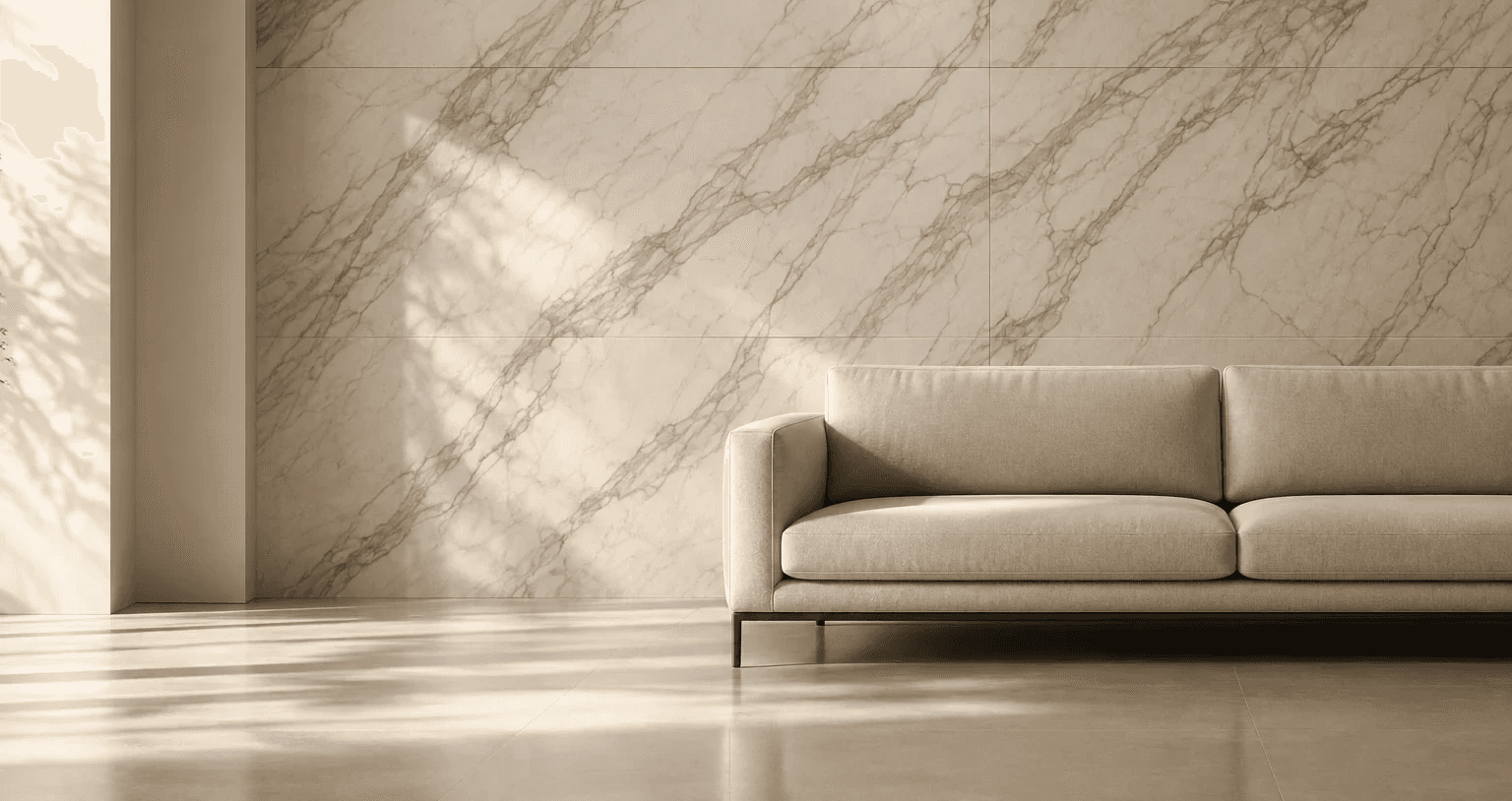
Natural stone rewards patience and punishes assumption. Two stones can look nearly identical on a sample board and diverge completely once installed, one enduring decades of daily use, the other showing wear within a season.
The difference rarely lies in colour or veining. It lies in how the stone was formed, how it responds to acid, and how much moisture it holds, the properties a specification should be built on, not the impression a swatch makes in good light.
This guide considers seven of the natural stone families most often specified today, marble, granite, quartzite, limestone, travertine, onyx, and sandstone, what each one is, how it behaves, and where it belongs in a project.
Marble
Marble is born of pressure. Limestone, subjected to heat and geological force, recrystallises into the veined, luminous stone specifiers have reached for since antiquity. No two blocks read the same way, which is precisely its appeal, and its limitation.
Hardness: Mohs 3-4 Porosity: moderate Acid sensitivity: high, etches on contact with lemon, vinegar or wine
It suits feature walls, low-traffic flooring, bathroom surrounds, and bookmatched statement panels, anywhere it's spared regular contact with acid. Kitchen counters ask more of marble than it can reliably give, unless it's sealed and looked after with real consistency.

A bookmatched wall that feels like art.
A sculpted fluted panel that turns a corridor into a tactile experience. A quartzite slab in a high-traffic hotel lobby that survives everything yet ages beautifully.
Designers today aren’t buying stone, they’re curating stories.
And the modern client?
They’re smarter, more aware, and more intentional about what “luxury” means. Sustainability matters. Longevity matters. Origin matters. In fact, recent reports from the Natural Stone Institute show that durable natural materials are now preferred over synthetics in premium projects because they outlast, outperform, and simply feel more human.
This is why natural stone is back. Not because it replaced something else, but because we rediscovered its relevance.
In a world that moves quickly, real materials slow us down. They remind us that beauty takes time. They ground a space. They anchor a home. And more than anything, they age with us, gracefully, honestly, and with character.
As we begin this newsletter series, our hope is to take you behind the surfaces you see every day and into the making, meaning, and magic of natural stone. Because luxury isn’t the final shine on a polished slab. It’s everything that came before it.
And this, this return to origin, craft, and authenticity, is just the beginning of a new chapter.
Blog
Types of Natural Stone: A Guide to Seven Stone Families
Natural stone rewards patience and punishes assumption. Two stones can look nearly identical on a sample board and diverge completely once installed, one enduring decades of daily use, the other showing wear within a season.
The difference rarely lies in colour or veining. It lies in how the stone was formed, how it responds to acid, and how much moisture it holds, the properties a specification should be built on, not the impression a swatch makes in good light.
This guide considers seven of the natural stone families most often specified today, marble, granite, quartzite, limestone, travertine, onyx, and sandstone, what each one is, how it behaves, and where it belongs in a project.
Marble
Marble is born of pressure. Limestone, subjected to heat and geological force, recrystallises into the veined, luminous stone specifiers have reached for since antiquity. No two blocks read the same way, which is precisely its appeal, and its limitation.
Hardness: Mohs 3-4 Porosity: moderate Acid sensitivity: high, etches on contact with lemon, vinegar or wine
It suits feature walls, low-traffic flooring, bathroom surrounds, and bookmatched statement panels, anywhere it's spared regular contact with acid. Kitchen counters ask more of marble than it can reliably give, unless it's sealed and looked after with real consistency.

A bookmatched wall that feels like art.
A sculpted fluted panel that turns a corridor into a tactile experience. A quartzite slab in a high-traffic hotel lobby that survives everything yet ages beautifully.
Designers today aren’t buying stone, they’re curating stories.
And the modern client?
They’re smarter, more aware, and more intentional about what “luxury” means. Sustainability matters. Longevity matters. Origin matters. In fact, recent reports from the Natural Stone Institute show that durable natural materials are now preferred over synthetics in premium projects because they outlast, outperform, and simply feel more human.
This is why natural stone is back. Not because it replaced something else, but because we rediscovered its relevance.
In a world that moves quickly, real materials slow us down. They remind us that beauty takes time. They ground a space. They anchor a home. And more than anything, they age with us, gracefully, honestly, and with character.
As we begin this newsletter series, our hope is to take you behind the surfaces you see every day and into the making, meaning, and magic of natural stone. Because luxury isn’t the final shine on a polished slab. It’s everything that came before it.
And this, this return to origin, craft, and authenticity, is just the beginning of a new chapter.