Blog
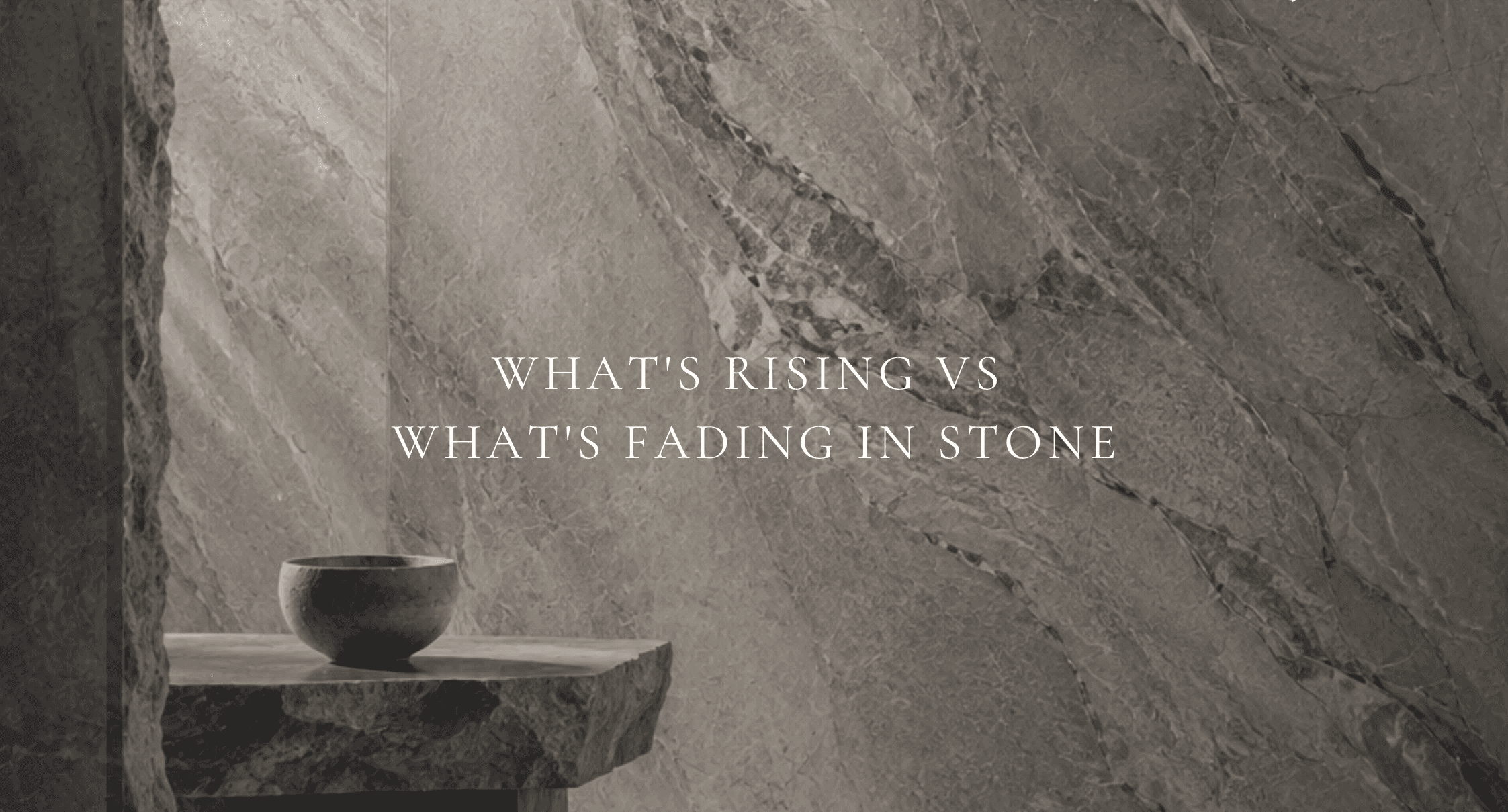
Stone Trends 2026: What's Rising vs Fading, Through an Architect's Lens

Why "trending" is the wrong question for architects
A new stone gets crowned "the one to spec" almost every season. Most don't survive the next one. For a material that's going into a project for decades, chasing what's current is the wrong test. The better question is which shifts are structural, driven by how people actually want to live and work, or by real changes in health and sourcing standards, and which are simply of-the-moment.
Here's what we're seeing move, across six areas, drawn from current design press, fabricator data, and our own conversations with architects and interior designers.
1. Finish: honed and leathered over high-gloss polish
Matte, tactile finishes (honed, leathered, brushed) are steadily replacing high-gloss polish as the default choice, particularly in kitchens, bathrooms, and hospitality interiors. "Ultra-glossy surfaces can feel a bit artificial and overly polished," interior designer Jessica Gersten told Homes & Gardens in 2026. A finish is a maintenance decision as much as an aesthetic one: matte surfaces show fewer fingerprints and etch marks, read calmer in renderings, and age more gracefully on site. Polish isn't gone, but it's becoming a deliberate specification rather than the automatic one.

Matte, tactile finishes (honed, leathered, brushed) are steadily replacing high-gloss polish as the default choice, particularly in kitchens, bathrooms, and hospitality interiors.

Warm stone reads as inhabited rather than showroom-perfect, and pairs more naturally with timber, brass, and linen finishes that are also trending.
2. Colour: warm and characterful over stark and cold
Stark white countertops and cold-veined slabs, long treated as the "safe" choice, are giving ground to warmer, earthier stone: travertine, warm-toned quartzites, and marbles with soft beige, taupe, and gold undertones. "Stark white countertops are starting to feel overly clinical," Cosentino's Katie Parry Stone told Homes & Gardens; architect Andrew Franz, in the same piece, was blunter still: "Neutrals, while always safe, have lost their appeal." Warm stone reads as inhabited rather than showroom-perfect, and pairs more naturally with timber, brass, and linen finishes that are also trending.
3. Application: bookmatched and large-format over segmented tiling
Bookmatched slabs (two pieces of stone mirrored to create a symmetrical veining pattern) and large-format, floor-to-ceiling installations are increasingly specified over smaller, segmented tiling with visible grout lines. Fabricators report book-matched wall panels being requested for full-height bathroom and living-room features across current projects (Majestic Stone Lab, 2026). Fewer joins create more visual continuity, letting the material carry more of the architectural statement rather than simply finishing a surface.

Bookmatched slabs (two pieces of stone mirrored to create a symmetrical veining pattern) and large-format, floor-to-ceiling installations are increasingly specified over smaller, segmented tiling with visible grout lines.
4. Character: natural variation over manufactured uniformity
Visible quarry marks, raw edges, and natural colour variation within a batch are being embraced rather than selected out. European architects are increasingly specifying "raw, split-face finishes, visible quarry marks, and intentionally irregular edges" rather than polished, uniform surfaces, according to a 2026 industry review by Vardman Industries. Perfectly uniform, "flawless" slabs now read as manufactured rather than premium. This shows up most clearly in split-face and raw-edge applications, where the point is to let the stone look unmistakably like stone.

Visible quarry marks, raw edges, and natural colour variation within a batch are being embraced rather than selected out. (Image Source : Oxidesign)

Engineered "quartz" surfaces (roughly 90% crystalline silica by content, compared to 45–50% in granite) have come under growing regulatory and health scrutiny.
5. Role in the room: sculptural feature over flat surface
Stone is moving beyond countertops and floors into sculptural territory: fluted panels with carved vertical ridges, backlit onyx and translucent stone in bars and spas, and full-height feature walls in entries and bathrooms. Backlit onyx and translucent stone are increasingly used architecturally in bars, spas, and hospitality counters for experiential impact (China Stone Select, 2026). The brief has shifted from "what's the countertop material" to "where's the moment in this space," and stone is increasingly the answer to the second question, not just the first.
6. Specification logic: performance and provenance over default engineered surfaces
This is the shift with the most structural weight behind it. Engineered "quartz" surfaces (roughly 90% crystalline silica by content, compared to 45–50% in granite) have come under growing regulatory and health scrutiny. Australia has banned high-silica engineered stone outright, and California has moved toward stricter workplace safety standards following a rise in silicosis cases among fabricators (The Architect's Newspaper, 2024). One architect told the publication that a kitchen benchtop is not worth risking a person's health over. That's prompting some architects to look again at natural stone, particularly quartzite, for its combination of durability and a cleaner story on health, sourcing, and longevity. Cost and material availability still limit how far this shift goes, and it isn't an India regulation yet, but it's a live consideration in specification conversations now, not a fringe one. Closer to home, the same pull toward warmth and texture is showing up in India too: demand spanning "Jaipur quartzites to rainforest marble," including green Bidasar and beige travertine, as architects favour tactile, characterful stone over flat neutrals (Vasterior Studio, 2026).
What this means for your next brief
None of these six shifts are about novelty for its own sake. Tactile finishes, warmer palettes, larger continuous applications, embraced natural variation, stone as sculptural feature, and performance-and-provenance-led specification all point the same direction: toward material honesty over manufactured perfection. That's a useful filter for the next brief: ask whether a choice is answering a real shift in how people want to live and build, or whether it's a stone having a moment that won't survive the next one. If you're speccing stone for an upcoming project (across marble, onyx, travertine, quartzite, granite, or limestone), our team can walk you through current samples and sourcing options.
Sources
- Homes & Gardens, "7 Kitchen Countertop Colors and Materials Going Out of Style in 2026": designer-quoted fading/rising pairs: stark white, Taj Mahal quartzite, quartz, glossy finishes
- Cupa Stone, "6 Key Interior and Architectural Trends for 2026": façades, large-format porcelain/stone blending, material honesty
- Brachot Academy, "Natural Stone Trends 2026: Curves & Contrast": organic shapes, warm palette, tactility
- China Stone Select, "Top 10 Natural Stone Trends Reshaping Luxury Interiors in 2026": large-format slabs, honed/textured finishes, backlit stone, EPDs
- Vardman Industries, "2026 Natural Stone Trends: What European Architects Are Specifying": raw/split-face finishes, regional stone revival, natural variation embraced
- Majestic Stone Lab, "Modern Marble Trends: What Architects & Designers Are Using in 2026": bookmatching, fluted marble, expanding applications
- The Architect's Newspaper, "As Silicosis Cases Rise, Architects Reconsider Engineered Stone": silica content data, Australia ban, California rules, shift toward natural stone
- Vasterior Studio, "Top 10 Interior Design Trends 2026 India": India-specific natural stone trend (Jaipur quartzites, green Bidasar, travertine)
- Dezeen, "Marmomac 2025 Presents the Latest Innovations for the Stone Industry": 2025 fair programming: quarrying, processing, surface treatment, automation
- Stone World, "Marmomac 2025 Presents STONE NEXT: Innovation in Natural Stone": research, craftsmanship and experimentation as the fair's framing for stone's future
Blog
Stone Trends 2026: What's Rising vs Fading, Through an Architect's Lens
Why "trending" is the wrong question for architects
A new stone gets crowned "the one to spec" almost every season. Most don't survive the next one. For a material that's going into a project for decades, chasing what's current is the wrong test. The better question is which shifts are structural, driven by how people actually want to live and work, or by real changes in health and sourcing standards, and which are simply of-the-moment.
Here's what we're seeing move, across six areas, drawn from current design press, fabricator data, and our own conversations with architects and interior designers.
1. Finish: honed and leathered over high-gloss polish
Matte, tactile finishes (honed, leathered, brushed) are steadily replacing high-gloss polish as the default choice, particularly in kitchens, bathrooms, and hospitality interiors. "Ultra-glossy surfaces can feel a bit artificial and overly polished," interior designer Jessica Gersten told Homes & Gardens in 2026. A finish is a maintenance decision as much as an aesthetic one: matte surfaces show fewer fingerprints and etch marks, read calmer in renderings, and age more gracefully on site. Polish isn't gone, but it's becoming a deliberate specification rather than the automatic one.
Matte, tactile finishes (honed, leathered, brushed) are steadily replacing high-gloss polish as the default choice, particularly in kitchens, bathrooms, and hospitality interiors.
Warm stone reads as inhabited rather than showroom-perfect, and pairs more naturally with timber, brass, and linen finishes that are also trending.
2. Colour: warm and characterful over stark and cold
Stark white countertops and cold-veined slabs, long treated as the "safe" choice, are giving ground to warmer, earthier stone: travertine, warm-toned quartzites, and marbles with soft beige, taupe, and gold undertones. "Stark white countertops are starting to feel overly clinical," Cosentino's Katie Parry Stone told Homes & Gardens; architect Andrew Franz, in the same piece, was blunter still: "Neutrals, while always safe, have lost their appeal." Warm stone reads as inhabited rather than showroom-perfect, and pairs more naturally with timber, brass, and linen finishes that are also trending.
3. Application: bookmatched and large-format over segmented tiling
Bookmatched slabs (two pieces of stone mirrored to create a symmetrical veining pattern) and large-format, floor-to-ceiling installations are increasingly specified over smaller, segmented tiling with visible grout lines. Fabricators report book-matched wall panels being requested for full-height bathroom and living-room features across current projects (Majestic Stone Lab, 2026). Fewer joins create more visual continuity, letting the material carry more of the architectural statement rather than simply finishing a surface.
Bookmatched slabs (two pieces of stone mirrored to create a symmetrical veining pattern) and large-format, floor-to-ceiling installations are increasingly specified over smaller, segmented tiling with visible grout lines.
4. Character: natural variation over manufactured uniformity
Visible quarry marks, raw edges, and natural colour variation within a batch are being embraced rather than selected out. European architects are increasingly specifying "raw, split-face finishes, visible quarry marks, and intentionally irregular edges" rather than polished, uniform surfaces, according to a 2026 industry review by Vardman Industries. Perfectly uniform, "flawless" slabs now read as manufactured rather than premium. This shows up most clearly in split-face and raw-edge applications, where the point is to let the stone look unmistakably like stone.
Visible quarry marks, raw edges, and natural colour variation within a batch are being embraced rather than selected out. (Image Source : Oxidesign)
Engineered "quartz" surfaces (roughly 90% crystalline silica by content, compared to 45–50% in granite) have come under growing regulatory and health scrutiny.
5. Role in the room: sculptural feature over flat surface
Stone is moving beyond countertops and floors into sculptural territory: fluted panels with carved vertical ridges, backlit onyx and translucent stone in bars and spas, and full-height feature walls in entries and bathrooms. Backlit onyx and translucent stone are increasingly used architecturally in bars, spas, and hospitality counters for experiential impact (China Stone Select, 2026). The brief has shifted from "what's the countertop material" to "where's the moment in this space," and stone is increasingly the answer to the second question, not just the first.
6. Specification logic: performance and provenance over default engineered surfaces
This is the shift with the most structural weight behind it. Engineered "quartz" surfaces (roughly 90% crystalline silica by content, compared to 45–50% in granite) have come under growing regulatory and health scrutiny. Australia has banned high-silica engineered stone outright, and California has moved toward stricter workplace safety standards following a rise in silicosis cases among fabricators (The Architect's Newspaper, 2024). One architect told the publication that a kitchen benchtop is not worth risking a person's health over. That's prompting some architects to look again at natural stone, particularly quartzite, for its combination of durability and a cleaner story on health, sourcing, and longevity. Cost and material availability still limit how far this shift goes, and it isn't an India regulation yet, but it's a live consideration in specification conversations now, not a fringe one. Closer to home, the same pull toward warmth and texture is showing up in India too: demand spanning "Jaipur quartzites to rainforest marble," including green Bidasar and beige travertine, as architects favour tactile, characterful stone over flat neutrals (Vasterior Studio, 2026).
What this means for your next brief
None of these six shifts are about novelty for its own sake. Tactile finishes, warmer palettes, larger continuous applications, embraced natural variation, stone as sculptural feature, and performance-and-provenance-led specification all point the same direction: toward material honesty over manufactured perfection. That's a useful filter for the next brief: ask whether a choice is answering a real shift in how people want to live and build, or whether it's a stone having a moment that won't survive the next one. If you're speccing stone for an upcoming project (across marble, onyx, travertine, quartzite, granite, or limestone), our team can walk you through current samples and sourcing options.
Sources
- Homes & Gardens, "7 Kitchen Countertop Colors and Materials Going Out of Style in 2026": designer-quoted fading/rising pairs: stark white, Taj Mahal quartzite, quartz, glossy finishes
- Cupa Stone, "6 Key Interior and Architectural Trends for 2026": façades, large-format porcelain/stone blending, material honesty
- Brachot Academy, "Natural Stone Trends 2026: Curves & Contrast": organic shapes, warm palette, tactility
- China Stone Select, "Top 10 Natural Stone Trends Reshaping Luxury Interiors in 2026": large-format slabs, honed/textured finishes, backlit stone, EPDs
- Vardman Industries, "2026 Natural Stone Trends: What European Architects Are Specifying": raw/split-face finishes, regional stone revival, natural variation embraced
- Majestic Stone Lab, "Modern Marble Trends: What Architects & Designers Are Using in 2026": bookmatching, fluted marble, expanding applications
- The Architect's Newspaper, "As Silicosis Cases Rise, Architects Reconsider Engineered Stone": silica content data, Australia ban, California rules, shift toward natural stone
- Vasterior Studio, "Top 10 Interior Design Trends 2026 India": India-specific natural stone trend (Jaipur quartzites, green Bidasar, travertine)
- Dezeen, "Marmomac 2025 Presents the Latest Innovations for the Stone Industry": 2025 fair programming: quarrying, processing, surface treatment, automation
- Stone World, "Marmomac 2025 Presents STONE NEXT: Innovation in Natural Stone": research, craftsmanship and experimentation as the fair's framing for stone's future